Share This

Showing posts with label Education. Show all posts

Thursday, January 22, 2026

View the ‘shocking’ university ranking with composure


Photo: VCG


The newly released "Leiden Rankings" from the Netherlands has recently drawn widespread attention. Eight of the world's top ten universities on the list are from China, with Zhejiang University ranking first, while Harvard University of the US - long a fixture at the top - fell to third place. The results sparked intense discussion. The New York Times published an in-depth analysis under the headline Chinese Universities Surge in Global Rankings as US Schools Slip, while France's Le Monde reported on January 20 that the ranking had triggered widespread shock, noting that the rise of Chinese universities has made the West less certain of itself. How should one view this "shocking" ranking? Our answer is simple: with composure.

First, the ranking does reflect, to a considerable extent, China's advances in education and science and technology. The Centre for Science and Technology Studies at Leiden University in the Netherlands, which publishes the ranking, is highly respected in the global field of scientometrics. The ranking focuses primarily on research output in high-impact international academic journals. Chinese scholars have ranked first globally for years in both the volume of SCI-indexed papers and citation counts. Judged by these criteria, it is hardly accidental that Chinese universities occupy eight of the top ten positions. In 2025, China's research and development (R&D) spending intensity reached 2.8 percent, surpassing the average of economies in the Organization for Economic Co-operation and Development (OECD) for the first time. The rise of many Chinese universities in the rankings is therefore a natural outcome of China's long-standing commitment to the strategy of invigorating China through science and education, coupled with sustained increases in research investment.

Most of the Chinese universities ranked in the top ten are research-oriented institutions with strengths in science and engineering, such as Tsinghua University, Zhejiang University, and Shanghai Jiao Tong University. What the ranking effectively "captures" is the growing competitiveness of China in fields such as electronic communication, materials science, physics, and chemistry. From Huawei's 5G technologies to the Tianhe supercomputers, and to the quantum satellite "Micius," Chinese university research teams have played a direct, critical, and in-depth role behind these achievements. The continuous flow of innovation generated by Chinese universities has been a powerful driver of China's transition from a major manufacturing country to a major science and technology power.

However, it is important to remain clear-eyed about the limitations of this ranking, which has a distinct focus - or preference. It places greater emphasis on universities' performance in academic research publications, reflecting only part of the picture rather than the whole. Judged by more comprehensive indicators, the more widely recognized global university rankings remain the QS World University Rankings, the Times Higher Education World University Rankings, and ShanghaiRanking's Academic Ranking of World Universities. In these rankings, universities from the US and the UK continue to dominate the top tiers. In terms of research originality, global talent attraction, and employer reputation, established Western universities still enjoy advantages. These gaps also serve as a reminder that the overall strength of Chinese universities - particularly their capacity to translate integrated technologies into real-world applications and their models for cultivating innovative talent - still has room for further improvement. 

Even so, in early 2000, the same Leiden Ranking still had seven US universities among the top 10, while Zhejiang University only made it into the top 25. Today, although Harvard produces even more research than it did back then, it has slipped to the third place. Given the progress made by Chinese universities over the past two decades, it is hardly difficult to understand why Western media might feel "shocked." This ranking has overturned many long-held perceptions. In fact, Chinese universities did not seize the spotlight "overnight." In recent years, from advances in basic research and breakthroughs in frontier technologies to leaps in strategic industries, China's scientific and technological rise has long been visible to the world. As universities serve as a "reservoir" for scientific and technological development, it is only natural that higher education institutions have made corresponding gains.

As for some Western media outlets linking the Leiden Ranking to narratives of "shifting power" or even a "new world order," this is an overreaction. Behind such "shock" lies Western anxiety over the erosion of technological hegemony. In reality, the progress of Chinese universities does not imply the failure of the West; rather, it represents a "collective increment" in humanity's overall creation of knowledge. From Harvard's liberal education to Stanford's entrepreneurial incubation, drawing on advanced educational philosophies from developed countries has itself been part of the progress of Chinese universities. At a time when global knowledge cooperation is becoming ever more closely intertwined, only by breaking free from zero-sum thinking can humanity's scientific enterprise advance together.

In a sense, the Leiden Ranking is like a mirror, reflecting both our achievements and our shortcomings. Every year, many Chinese students cross oceans to pursue their studies, with venerable Western institutions such as Harvard and Oxford remaining their "dream schools." We also hope that in the future, more international students will come to regard Chinese universities as their own "dream schools" and choose to study in China. That would be a far more persuasive kind of "ranking." 

 Global Times editorial

Wednesday, October 15, 2025

Be cautious, students told as influenza wave hits schools and kindies


Photo courtesy of Pexels

PETALING JAYA: With schools and kindergartens not spared from the current influenza wave hitting the country, the alert is out for children to take extra precautionary measures.

Health experts want special emphasis given to children as most cases have been detected in schools.

Public health expert Prof Dr Sharifa Ezat Wan Puteh called for the affected schools to be closed after being sanitised.

She said children with influenza-­like illness (ILI) symptoms should stay home, while those with severe acute respiratory illness (Sari) should seek treatment at the hospital.

ALSO READ:

“Children are also encouraged to get a flu jab. Annual vaccination is necessary because influenza viruses change over time and the vaccine is updated each year.

“The vaccine is suitable for individuals aged six months and older,” she said when contacted.

The Health Ministry has repor­ted a nationwide increase in ILI cases, with 97 clusters detected in the latest epidemiolo­gical week – a sharp jump from just 14 the week before.

CLICK TO ENLARGECLICK TO ENLARGE

Most outbreaks were recorded in schools and kindergartens, mainly in Selangor, Kuala Lumpur and Penang.

On Saturday, the ministry reminded that early treatment was important to prevent serious complications.

It said that while influenza was usually resolved without specific treatment, those who experienced symptoms such as fever, cough, sore throat, body aches or fatigue should seek medical attention, mainly children and those at high risk.

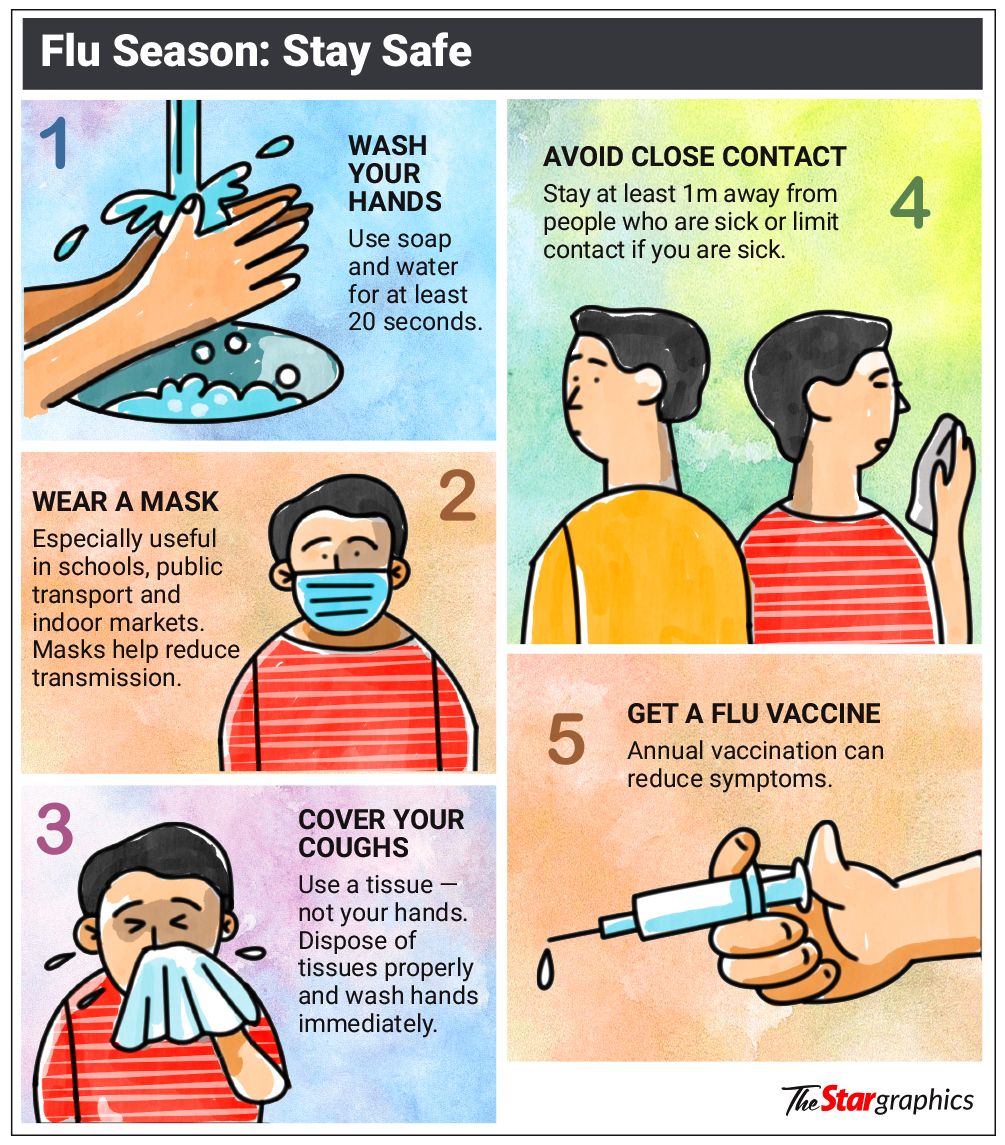
The ministry also urged the public to practise proper cough etiquette, maintain regular hand hygiene, avoid crowded places when unwell and wear face masks if they were symptomatic.

Health Minister Datuk Seri Dr Dzulkefly Ahmad said his ministry will discuss with the Education Ministry on further action to contain the spread of the virus in schools.

He also sought to reassure the public that the situation remained under control despite a concerning number of outbreaks.

Prof Sharifa Ezat, who is Univer­siti Kebangsaan Malaysia’s School of Liberal Studies dean, said high-risk groups in­­cluded the elderly, those with comor­bidi­ties, cancer patients and pregnant women.

She added that other groups, such as healthcare workers, teachers with high student load and those handling work which involves meeting a lot of people, should also mask up to protect themselves.

Malaysian Medical Association (MMA) president Datuk Dr Thiru­navukarasu Rajoo urged the public to take sensible precautions with cases of Influenza A and B continuing to rise nationwide.

He said the increase in flu clusters being detected by the Health Ministry was not unusual during this time of the year, but stressed that vigilance is key to preventing a further spread.

“Good hygiene remains our best defence – wash your hands frequently, cover coughs and sneezes and wear a mask if feeling unwell or in crowded areas,” he said.

Dr Thirunavukarasu advised those with persistent high fever, severe cough, chest discomfort or breathing difficulties to seek immediate medical attention, especially if symptoms did not improve after a few days.

President of the Association of Private Hospitals Malaysia Dr Kuljit Singh said the resulting increase in demand for flu vaccines is still manageable.

“We have stock from suppliers, despite the surge in cases,” he said, adding that demand for the jab usually goes up during the flu season.

Former Medical Practitioners Coalition Association of Malaysia president Dr Raj Kumar Maharajah also said there is enough stock of the vaccine at the moment.

“Many are coming in for vaccines due to the influenza outbreak,” he said.

Related stories:

Tuesday, June 17, 2025

US varsities losing ground, as fewer Malaysian students heading to the US

Changing us policies, stronger greenback contributing to drop in numbers

Global prestige: A file photo of people walking between buildings on the campus of Harvard University in Cambridge, Massachusetts on Dec 17, 2024. Nearly 6,800 international students are enrolled in Harvard’s 2024-2025 school year, amounting to 27% of its total enrolment. — AP

Malaysian student arrivals in the United States have dropped by 7% from January to April – the biggest decline among Asean countries – amid policy uncertainty, rising costs and changing preferences. The numbers remain below pre-pandemic levels as more students explore alternative or shorter, cost-effective study options.

Malaysian student arrivals in the United States have declined this year amid ongoing uncertainties surrounding US foreign student policies.

According to figures from the US National Travel and Tourism Office website, the number of Malaysians arriving in the United States on student visas from January to April this year dropped by 7% to 1,754 compared to 1,887 in the same period last year.

Education consultants said the uncertainties – coupled with rising costs due a stronger US dollar and shifting student preferences – are contributing to the decline.

These factors, they note, have prompted some students to explore alternative destinations or opt for study programmes that involve shorter stays in the United States.

Malaysia’s 7% drop is the largest among Asean countries.

Thailand had the second biggest decline at -3.1%, followed by Indonesia at -2.3%.

All Asean countries recorded a drop in student arrivals to the United States from January to April this year, except for Vietnam, which saw a 21% increase.

Vietnam sent 25,206 students to the United States last year, the biggest number among Asean countries.

Singapore was second (9,639) followed by Thailand (7,081).

Amid policy changes introduced during the Trump administration, some Malaysian students are reconsidering their plans to pursue higher education in the United States.

Concerns intensified following reports that US Secretary of State Marco Rubio had instructed embassies to suspend the scheduling of student visa interviews – part of a broader push by the administration to expand social media screening for visa applicants.

On June 6, the US State Department reportedly instructed consulates worldwide to resume processing visa applications for international students admitted to Harvard University, reversing earlier guidance to reject such requests.

The figures from the US National Travel and Tourism Office, which go back to 2015, show that about 8,000 Malaysians arrived in the United States on student visas each year.

The Covid-19 pandemic led to a drop to below 3,000 student arrivals in 2020.

The figures have been increasing each year since, but have still not fully recovered to pre-pandemic levels, with 5,223 Malaysian student arrivals recorded last year.

When contacted, the US Embassy in Kuala Lumpur said it had no further remarks to add to earlier comments it had issued.

On June 3, the embassy had assured Malaysian students that applications for study in the United States remain open as usual, with no cancellations to previously scheduled visa appointments.

Higher education consultant Joey Ban said current political developments in the United States had contributed to the decline.

“When Trump took office in 2017, he implemented policies that were seen as rather unfriendly to international students,” said Ban, Principal Consultant at Edu Experts.

“The international student community anticipated similar or stricter policies this time around and shifted their focus to other destinations.”

She said the cost of higher education in the United States is a deterrent due to the strengthening US dollar.

“Few families have the financial capacity to support their children through a four-year bachelor’s degree programme in the United States.

“The duration to obtain a similar degree in the United Kingdom or Australia is also shorter.

“We also have quality options in Malaysia at a much lower cost. Interest is also gaining to study in China and South Korea,” she said.

Ng Yih Chen, president of the American Universities Alumni of Malaysia, said the drop in numbers is part of a long-term trend dating back to the Asian financial crisis in 1997.

“In the 1980s, there were over 10,000 Malaysian students in the United States, but since the mid1980s, even state-owned universities, which are more affordable, raised their tuition fees which have now doubled,” he said.

Ng said skewed negative portrayals of the United States on social media have further discouraged parents from sending their children there.

He added that continued uncertainty around US immigration and education policy had prompted many students to adopt a “wait-and-see” approach.

Doreen John, Head of Partnerships and Student Engagement at Sunway University’s School of American Education, said fluctuations in enrolment are normal and often influenced by currency exchange rates, safety concerns and policy changes.

She said increased competition from other countries and enhanced local education offerings have also shifted student preferences.

However, John added that US universities continue to hold strong appeal.

“The universities still welcome international students and have excellent systems, services and facilities to help them thrive,” she said.

Source link

Related stories:

Sunday, May 18, 2025

Vaping their way to drugs, dangerous


Pocket size: Widely available, small, colourful vape devices are also easy to conceal. — File photo

A DECADE ago, when e-cigarettes, or vapes, landed on our shores, tobacco cessation experts cautioned that the devices could be a gateway to smoking, and a threat to Malaysia’s goal of becoming a smoke-free nation.

Today, the fear is that vapes are luring teens to drugs, creating a generation addicted to substances even more dangerous than nicotine, Monash University Malaysia associate professor and KPJ Puteri Hospital consultant Dr Anne Yee told StarEdu.

Dr Yee, who is also a Universiti Malaya Centre of Addiction Sciences (UMCAS) adjunct professor and Addiction Medicine Association of Malaysia (AMAM) honorary secretary, said unregulated vape liquids are increasingly being mixed with unknown substances, making them more dangerous and addictive.

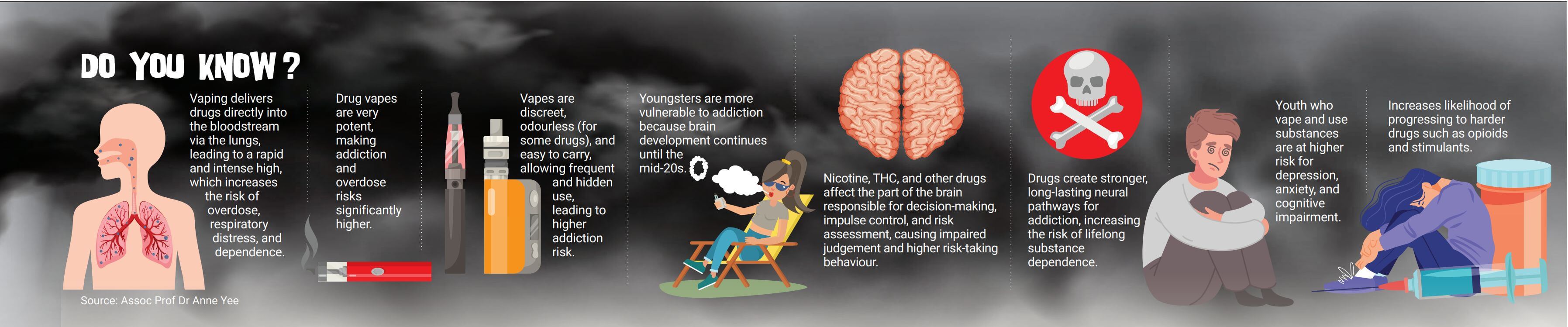
Vaping nicotine, Dr Yee noted, increases the likelihood of trying other addictive substances, including cannabis and illicit drugs.

Early exposure to nicotine primes the brain for further drug experimentation​, she said.

“Many vape products contain high levels of nicotine, increasing the risk of long-term addiction.

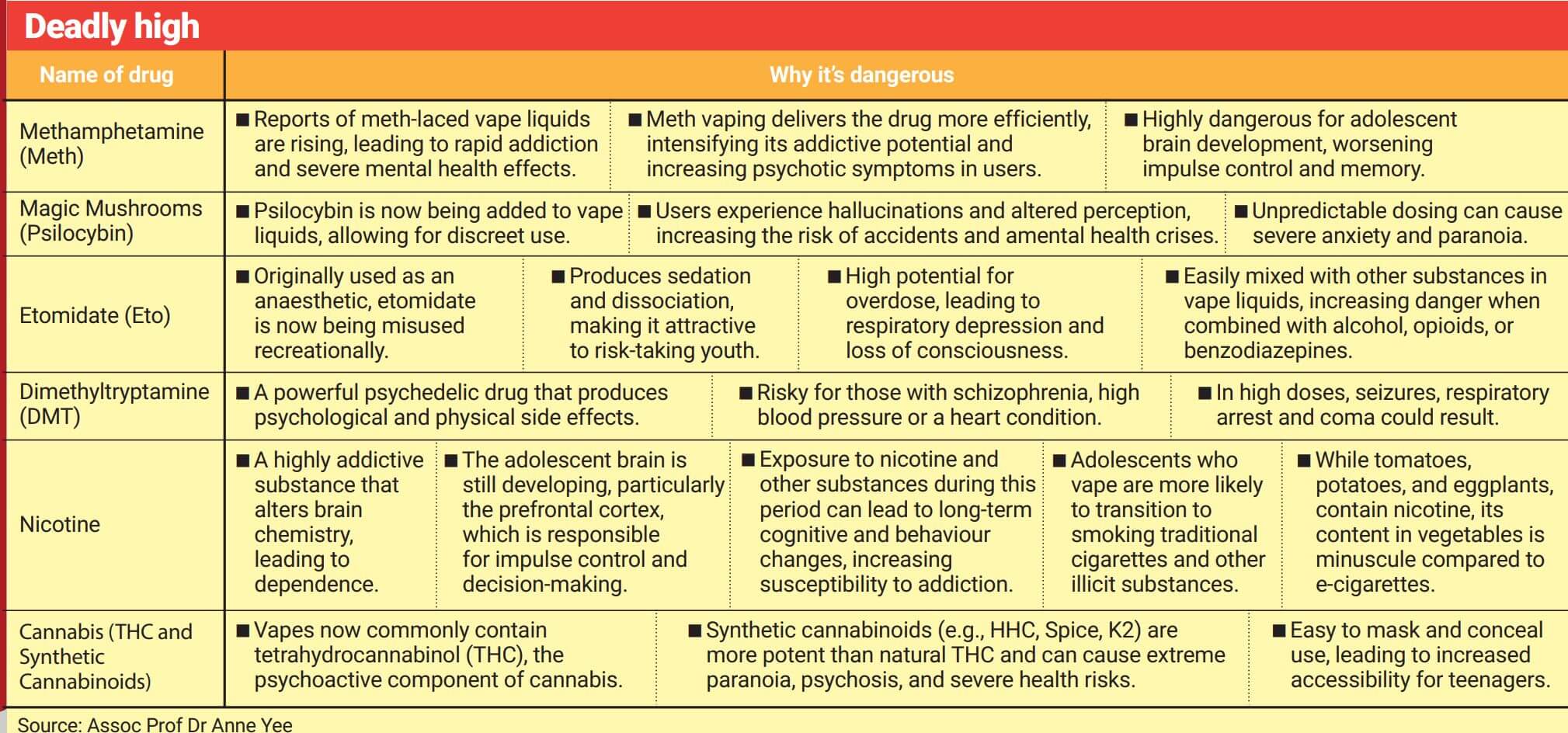
“The earlier a person starts using nicotine, the greater the risk of developing substance use disorders later in life,” she said, adding that vapes have been found to contain illicit substances such as THC, synthetic cannabinoids, or opioids (see infographic), which increase the risk of addiction, toxic chemical exposure, and the risk of respiratory and neurological damage.

“Youths may unknowingly inhale these dangerous substances as unregulated vape products are widely available online – especially social media,” she said.

Narcotic Addiction Rehabilitation Centre (Puspen) Karangan director Zuraidah Ayob said most of the teens at the facility get stuck on drugs through vaping.

“It’s very worrying because the numbers are increasing.

“During one visit to a school in Kuala Lumpur, I asked the 200 students gathered how many of them vaped. A quarter raised their hands. Those were the ones who admitted but imagine how many others who were afraid to raise their hands?” she said, adding that when vape was introduced, it was promoted as a healthier alternative to smoking but the vapour is not safe.

Most vapes contain nicotine levels that are higher than cigarettes, she said.

“Teens are getting hooked without even realising it because they see it as a trend rather than a high risk habit.

“Vape is a gateway to drugs and if not curtailed through education, enforcement and parental or community intervention, we will create a generation that is highly vulnerable to drug abuse,” she concluded.

Note: The Puspen Karangan school is in need of reading materials for its library, as well as volunteers to conduct tuition classes, skills training and motivational talks for its students. Companies interested in assisting as part of their corporate social responsibility programmes, or non-governmental organisations involved in education, may contact the school at zuraidah@aadk.gov.my or pengarah_karangan@aadk.gov.my

CLICK TO ENLARGECLICK TO ENLARGE

CLICK TO ENLARGECLICK TO ENLARGE

‘Mushrooms’ in our midst

Determined to turn over a new leaf, these students will sit for their Sijil Pelajaran Malaysia (SPM) exams this year at the country’s first Puspen school in Karangan, Kedah.

A typical day for these students starts at 9am and ends at 4.30pm. In between lessons at the school, which opened in December last year, co-curricular activities like computer classes are conducted, with students given a two-and-a-half-hour break for lunch.

In an exclusive interview with StarEdu, these students share how curiosity and friends led them to “magic mushrooms”.

Vaping, they say, should be banned because illegal substances are so easily available.

I was introduced to ‘mushrooms’ three years ago by a friend. Before I knew it, I was spending more than RM20 daily to feed my addiction. I got the liquid from a dealer and added it to my vape. The high would hit within five to 10 seconds, and I’d start to feel calm. Soon, I began feeling scared because the drug caused me to overthink. It slowed down my brain, and I was always forgetting stuff. I really regret trying it – if not for my curiosity, I wouln’t be here today. I hope vaping will be banned because many are abusing it. I want to continue my studies if I pass the SPM.

– Salman, 17, Selangor

CLICK TO ENLARGECLICK TO ENLARGEI used to take pil kuda (yaba pill) to give me energy when I worked in the paddy fields. I could not sleep at night so I turned to vaping ‘mushrooms’. I started when I was 13. My friend told me it would help with my insomnia and soon I was hooked. It’s only RM1 per drop and it is very easy to buy. Usually I would buy 10 drops and when I had some money, I would get a bottle for RM150, which could last me a week. It didn’t affect my studies because I was already skipping school anyway, but because I had been playing truant, my school called AADK. I was picked up and my urine test came back positive. It would be good to ban vaping because it is so easy to consume drugs with the device. No one will know. There is no smell at all. Please do not try it because when you are experiencing withdrawal, you really lose all control. I don’t crave it anymore, though sometimes I still have trouble sleeping.

– Kamal, 16, Terengganu

I am here because of ‘mushrooms’ introduced by friends. I was spending about RM700 and above per month on vaping. I come from a well-to-do family. My pocket money was RM40 daily. Sometimes I got more if I helped my mum, so I could save up to RM70 per day. If I had extra, I’d buy a bottle of mushroom liquid, which cost between RM90 and RM150. It’s widely available on social media. The first time I tried it, I thought, “Best le”. I felt happy – always laughing. I tried it for fun and was hooked for three years. I started with a little bit – over time, I felt I couldn’t do without it, so I was vaping 24 hours a day. I needed it as soon as I woke up. It interrupted my studies. I felt ‘heavy’ and couldn’t do anything. Many of my friends used it but I usually vaped alone or with my twin brother. He stopped a little bit earlier than me. I ‘kantoi’ last year during Raya. My mum woke me up on the morning of Raya and asked me to take a bath but I couldn’t wake up. She was angry and started scolding me. My brother came in and saw my vape. He knew what had happened. He asked me if it was ‘mushroom’ but I denied it. He didn’t believe me and tried it. He ended up losing consciousness. He woke up six hours later and couldn’t remember a thing. He told my mum. My mum gave me many chances until finally, the school found out and contacted AADK. Now, I am determined to do my best because in Puspen, the education is good – especially the aspects of religion and discipline. After SPM, I want to be a pilot but I wear specs so that may not be possible. If I can’t achieve what I want, I will continue my mum’s business as taukeh canteen. My first time trying drugs was through vape. It is so cheap and easy to buy. It should be banned. Please don’t be like me. You will ‘gian’ after the first try and it will be hard to stop.

– Adam, 17, Pahang

I don’t even drink alcohol but I started vaping in Form One and was introduced to meth and weed vape liquids. My friend said I would feel high so I wanted to try – 1ml was only RM30. One bottle was RM150. We would pool our money and share one bottle. Usually when I was high, my eyes would turn red but if I took too much, I got sleepy. For the longest time, no one knew. Every 30 minutes I would need to vape. The first time I tried, I felt nothing. And then I got addicted. I’d just spend my days sleeping. For three years, my mum tried to advise me but I couldn’t stop. This year is my SPM year, so she wants me to sit for the exams at Puspen. I am not angry with my mum for sending me here but I am sad. I know it’s for my own good. Now, I feel prepared for my SPM. Every two weeks, my parents will visit. If I could do things all over again, I would never touch this. No more drugs. I didn’t take drugs because of family problems. It was because of friends. I am an only child. My mother cried so many times. I felt so sad because I kept repeating my mistake. Even one drop can change your future. Just don’t try. The negative things that come with one try is not worth it. I want to be a policeman but I am scared that after this, I won’t get a chance. If I cannot join the force, I want to study to be a vet.

– Raghu, 17, Penang

I was always lazy to go to school – ‘kuat ponteng’ since Form Two. I had some issues at home. I got hooked on drugs at 17. It all started with normal vape until my friend introduced me to liquids with drugs. ‘Gian I kuat’ and I couldn’t stop. I couldn’t sleep because there was a lot on my mind. So I would vape before going to sleep. I was working part-time at a food stall. When I vaped, I couldn’t work. I felt lazy. Eventually, my boss found out. I ‘kantoi’ with mum. I was always sleeping and she suspected something was amiss. I used to also pace a lot and could not sit still. I was always dizzy. When my mum asked what’s wrong, I did not tell her. I tried to stop but I kept going back. I used ‘mushroom’ and would spend about RM10 to RM20 a day. I bought it from a friend. I really want to change. I want to get a good job and make my mum happy. When she sent me here, my mum told me to take care of myself and study properly. After my SPM, I want to take up vocational skills – to be an electrician. I am now focused on memorising my lessons for the SPM. School is good so far. I hope youths like me will be more selective when making friends. Avoid people who introduce you to bad things. Stay far, far away because once you start, it’s hard to stop.

– Amin, 19, Kedah

I’m the third of five siblings. When I was in Year One, my parents divorced. I could not accept that my father had remarried. My mum suffered from mental illness. I was Form One when I started vaping ‘mushrooms’. Before that, I was smoking cannabis for five years. Two years ago, my friend let me try ‘mushrooms’ with vape. Then I started using pil kuda together with the mushroom liquid. I had registered to sit for the SPM then but because I was high and hallucinating from ‘mushrooms’, I got into an accident and dropped out of school. I am excited to sit for my SPM this year because I have never been out of my home state. I entered Puspen unprepared but I have tried by best to face it. From my heart, I want to tell students like me – if you have girlfriend problems or whatever, don’t turn to drugs. You don’t need this in your life. I turned to drugs because I was disappointed with my girlfriend and family. When I was high, my family became like my enemy – I was aggressive with my parents. I just wanted money from them. I didn’t realise what I was doing. I would snatch money from my mum when she did not want to give it willingly. I couldn’t control my emotions and now I am here. My family finally put me here because they knew I was hanging out with the wrong crowd. I have been here for 11 months. My body is full of toxins now - pumped with drugs. I am learning to accept that I am an addict. I cannot go home because if I do, I will definitely go back to my friends. After SPM, the first thing I want to do is hug my mum and apologise to her because I spent this Raya without my family. I want to say thank you to my mum for everything and I want to make her proud of me. Even though society will always see the word ‘penagih’ stamped on my forehead, I will always try to make my mother proud – with everything that I have. I understand now my mum is sick, so as a son, I must try to move forward - away from the past hurt, and make her proud.

– Shukri, 19, Terengganu

*Names have been changed to protect the identities of the students.


CLICK TO ENLARGECLICK TO ENLARGE

CLICK TO ENLARGECLICK TO ENLARGE

Source link


Related stories:


15 hours ago — Today, the fear is that vapes are luring teens to drugs, creating a generation addicted to substances way more dangerous than nicotine.
Missing: pressreader ‎| Show results with: pressreader