KUALA LUMPUR: Property owners will have to be much more careful about who they rent to, following the announcement last week that the police will hold landlords responsible for crimes committed on their premises.
To help, the police have identified several red flags which owners should look out for when putting their premises up for rent.
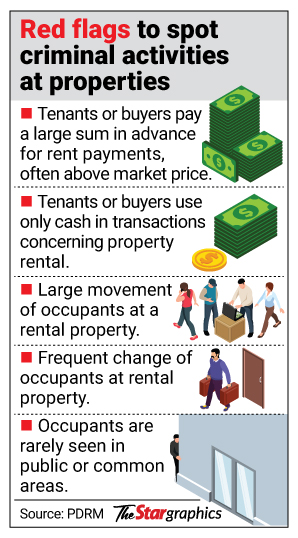
“Be wary of those who pay large sums for advance payments and deposits,” Comm Datuk Seri Ramli Mohamed Yoosuf told The Star.
“Criminals, especially scammers, have paid up to six, or even 10 months’ rent in advance for condominium units. In some cases, there are scammers who purchase properties in cash.”
The Bukit Aman Commercial Crime Investigation Department (CCID) director said landlords, joint management bodies (JMB) of high rises, and security companies should also watch out for large groups of people staying in one property.
“If a condominium unit has 20 to 30 people staying there and they are rarely seen, that is deemed suspicious,” he said.
“Frequent changes in occupants will also occur, as well as ordering food from ehailing services and having lookouts posted in the lobby in case the authorities raid the premises.
“These are the telltale signs of premises being used by criminals, especially scam syndicates.”
ALSO NREAD: Experts: Focus on criminals, don’t ‘victimise’ landlords
He added that landlords, JMBs, and security companies can no longer claim ignorance if criminal activities occur on their properties or, in the case of security companies, on premises they have been hired to guard.
“We are really serious about focusing on holding such parties liable if criminal activities, especially scam call centres, occur on their properties.
“As I mentioned previously, we will take action against them under Section 120B of the Penal Code for criminal conspiracy. No longer are actions solely focused on syndicate members,” he said.
In this context, Comm Ramli said the CCID is also proposing amendments for Section 108 of the Penal Code for abetment (aiding an offender committing a crime).
“While we can still take action under existing laws, the proposed amendments will give the police more jurisdictive power to further investigate owners of premises in connection with illegal activities occurring on their properties.
“We will also propose heavier penalties, including forfeiture of properties. We expect to submit the proposals to the Home Minister soon,” he said.
Following major crackdowns in Myanmar and Cambodia, scam syndicates are beginning to shift their call centres to other countries, including Malaysia.
This is why holding property owners, as well as security companies and JMBs, liable is vital, Comm Ramli said.
“Using the relevant laws will be a form of deterrent, making the three parties accountable, and in turn, reducing the number of scam call centres in the country,” he said.
ALSO READ: Urgent need for long-awaited residential tenancy law
Universiti Sains Malaysia criminologist Datuk Dr P. Sundramoorthy said landlords have various methods to evaluate whether potential tenants might pose a risk during the tenancy period.
“Landlords can implement evaluation thorough screening procedures, such as conducting background checks and verifying employment and rental history,” he added.
Sundramoorthy said landlords can also check references from previous landlords.
They should also assess the tenant’s financial stability and observe their behaviour and interactions, he said.
In addition, being vigilant about local crime patterns and staying informed through community reports can help landlords identify potential risks too.
The senior criminologist said homeowners and landlords can take proactive measures such as installing security cameras, good lighting and secure entry systems.
“They can also foster a sense of community among tenants by encouraging communication and reporting suspicious activity,” he said.
Malaysians Against Rape, Assault and Snatch Theft (Marah) founder Dave Avran concurred with Sundramoorthy, saying that landlords have a duty to conduct proper background checks and ensure their properties aren’t being used for illegal purposes.
“Too often, scammers set up operations in rented homes or office spaces with little to no oversight.
“If landlords faced penalties, they would be more cautious about whom they rent to, thus reducing the likelihood of such incidents,” he said.
In some cases, property owners knowingly turn a blind eye, he added.
“Critics point to landlords who ignore red flags like tenants paying in cash, frequently changing occupants, or restricting access to parts of the property,” he said.
Urgent need for long-awaited residential tenancy law
PETALING JAYA: Following the announcement last week by the police that they could hold landlords responsible for illegal activities carried out on their property, it is now more urgent than ever that the long-awaited Residential Tenancy Act (RTA) be tabled, say stakeholders.
Malaysian Institute of Estate Agents president Tan Kian Aun said the Act should be expedited to address the rising cases of property-related scams, illegal activities, and landlord-tenant disputes.
“We’ve received a lot of complaints, not only from the public but also from real estate agents.
“Landlords are discovering that their units are being used for illegal activities such as online scams, illegal call centres, and even gambling – often only after neighbours complain or the tenants stop paying rent,” he said when contacted.
He shared a case in which a landlord only discovered that his condominium unit had been turned into an illegal call centre when the electricity bill skyrocketed and neighbours complained of suspicious activity.
“The tenant had passed all checks and even paid a six-month deposit. But when they stopped answering calls, we found the place rigged with wiring and computer set-ups, all hidden from plain view.
“Most landlords only realise what’s happening when the rent stops coming in or the police knock on their door,” he said.
Kian Aun said one essential provision of the proposed RTA should be to grant landlords the right to inspect their properties.
“You cannot put all of the blame on landlords. But landlords must also take responsibility.
“If we allow inspections, at least the owner or their agent can verify that the unit is being used properly,” Kian Aun said.
Housing and Local Government Minister Nga Kor Ming recently said the ministry is still drafting the RTA, which aims to regulate landlord-tenant relationships and ensure that both parties are given their rights and fulfil their obligations throughout the tenancy.
Senior lawyer Marcus Tan Kian Han, managing partner of Marcus Tan & Co, said property owners and joint management bodies (JMBs) should not be held fully accountable for illegal activities carried out by tenants unless there are clear laws or regulations in place.
“Whether it is fair and reasonable to impose such duties and obligations on property owners and JMBs depends on whether there are existing laws or regulations which, at the moment, there are none,” he said.
“In the absence of legislation requiring property owners to take such measures, it may not be truly fair and reasonable. It becomes more of a matter of common sense rather than a legal duty.”
In the absence of clear laws, Marcus suggested that property owners take proactive measures to protect themselves, such as verifying and keeping copies of tenants’ identification documents like identity cards, passports, or company registration papers.
He said owners should conduct background checks using available databases like the Credit Tip-Off Service or insolvency portals, and even conduct basic online searches to identify any possible red flags.
He also advised owners to seek tenants’ written consent to carry out comprehensive background searches that could reveal litigation history, and to include a clause in tenancy agreements that allows owners to inspect the property under reasonable notice, as well as indemnity clauses to protect themselves.
Marcus recommended that owners engage solicitors to draft stronger tenancy agreements and to use professional tools such as Handshake or public databases, including sanctions or wanted lists, to perform deeper checks on potential tenants.
He said JMBs should require landlords to submit copies of tenants’ identity documents and tenancy agreements for record-keeping and security purposes.
He added that JMBs should immediately notify landlords if security guards detect any suspicious or illegal activities, and they should pay attention to tenants who share access cards or to visitors not listed in the records provided by the landlord.
He said that without clear policies or regulations, both property owners and JMBs remain vulnerable to being implicated in criminal activities carried out by tenants and that firm guidelines are necessary to provide clarity and protection for all parties involved.
Related stories:
- Experts: Focus on criminals, don’t ‘victimise’ landlords
- Urgent need for long-awaited residential tenancy law
- When dangerous activities are lurking behind closed doors