Share This

Showing posts with label unconventional monetary policy. Show all posts

Saturday, March 7, 2026

RM79.6bil windfall for EPF members


'CLICK TO ENLARGE'

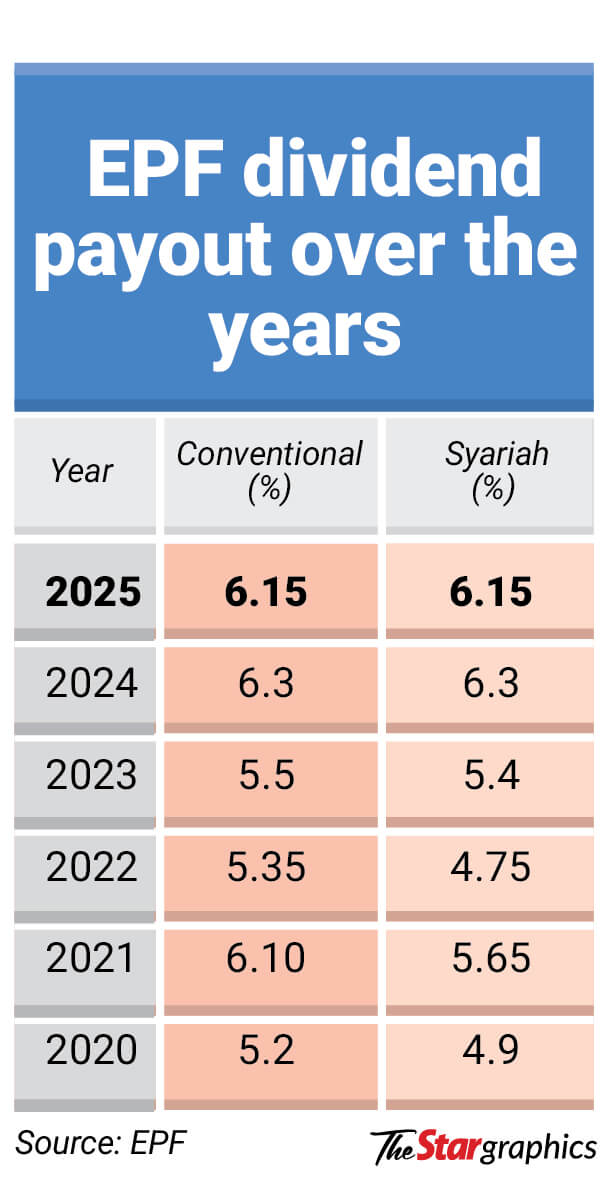
SHAH ALAM: The Employees Provident Fund (EPF) has declared a lower dividend for 2025 at 6.15% for both conventional and syariah accounts.

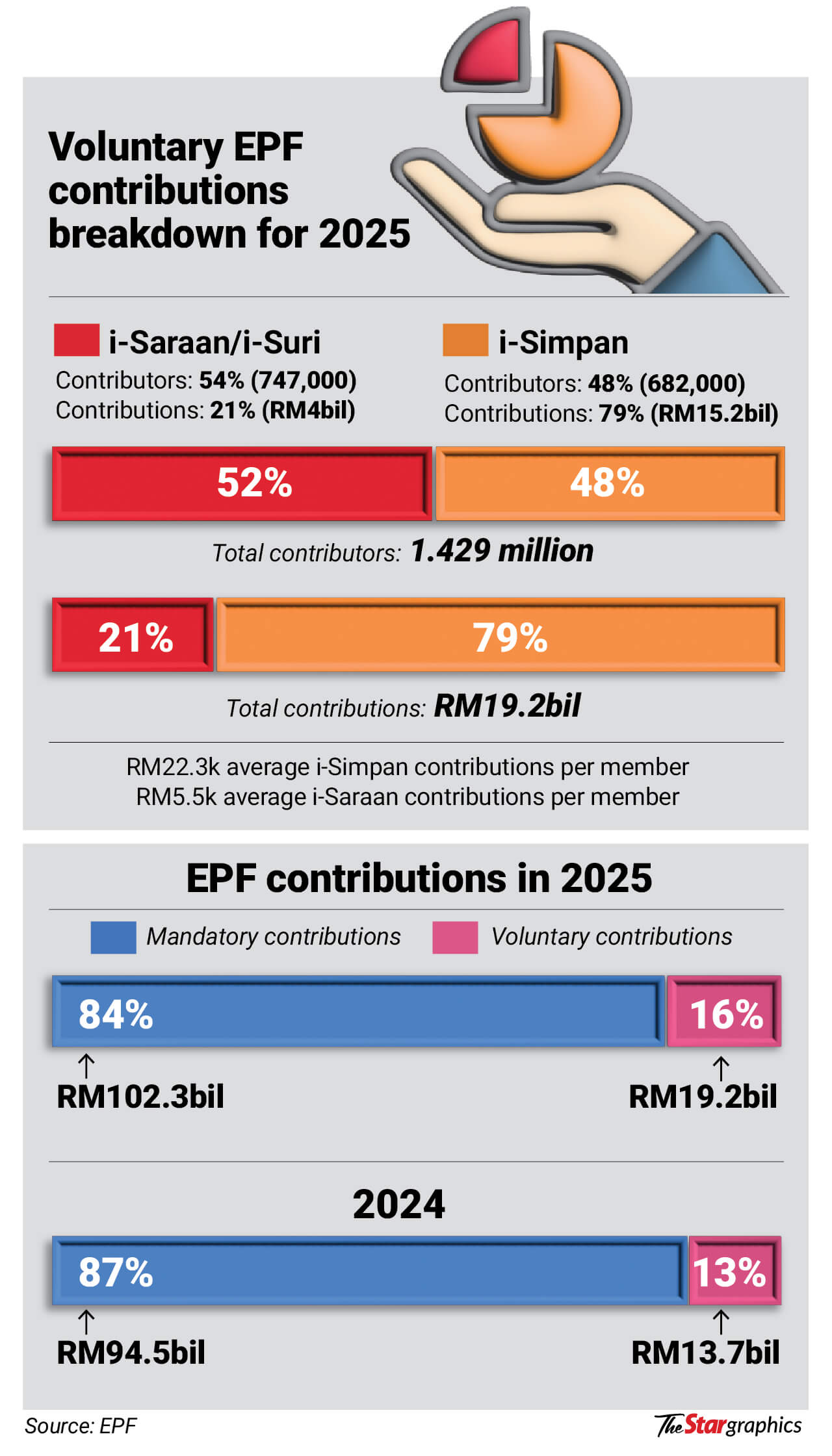
The total dividend payout for 2025 is RM79.6bil, whereby RM67.1bil is for conventional accounts and RM12.5bil for syariah accounts.

For 2024, the EPF declared a dividend rate of 6.3% for conventional savings with a total payout of RM63.05bil, as well as a 6.3% dividend for syariah savings, with a payout amounting to RM10.19bil.

EPF chief executive officer Ahmad Zulqarnain Onn attributed the lower payment to the slower growth of Bursa Malaysia’s Kuala Lumpur Composite Index (KLCI), which grew at 2.3% last year compared to about 12.9% in 2024.

Secondly, he said, assets denominated in the US dollar were also impacted due to the strength of the local currency.

The strengthening of the ringgit against the US dollar “impacted the value in ringgit of our income from dollar assets”, he said during the retirement fund’s dividend announcement yesterday.

“The ringgit does impact our international holdings and it was one of the best-performing currencies in the world, gaining 10.2%.”

The EPF recorded a total investment income of RM79.2bil for 2025, up from the RM74.46bil reported in 2024.

Investment assets grew to RM1.409 trillion, which is a 12.8% increase from the RM1.25 trillion recorded in the previous year, driven by portfolio income and net contributions of RM66.5bil.
'CLICK TO ENLARGE'
'CLICK TO ENLARGE'

The EPF recorded a total distributable income of RM82.7bil for 2025, up 9.5% from RM75.5bil in 2024.

Domestic investments continued to provide steady income, with 61.7% of the RM1.409 trillion worth of assets invested domestically. They generated investment income of RM39.3bil and accounting for 49.6% of total investment income.

Global investments, representing 38.3% of the portfolio, generated RM39.9bil and accounted for 50.4% of total investment income.

Ahmad Zulqarnain said the outlook for 2026 is moderate in the face of uncertainties.

“We believe economic growth will continue to be within expectations for most parts of the world, including continued growth in Malaysia,” he noted.

“Malaysia delivered 5.2% in 2025; the estimates are 4.3% for this year. But as we know, we also live in a world of great uncertainties, more so today than it has been for many decades.

“The risks are around trade policies, geopolitics, the path of inflation and, therefore, monetary policy and interest rates, increasing public debt, and the impact of artificial intelligence, which will create new winners and new losers. We believe Malaysia is in a good place,” he added.

“The top three themes for Malaysia that we believe will be persistent for the next decade are healthcare as we age as a nation, artificial intelligence, data and digitalisation as our personal and work lives become more and more digital, and energy as the world transitions to green energy.”
'CLICK TO ENLARGE'
'CLICK TO ENLARGE'

Meanwhile, the EPF will introduce the i-Legasi scheme, enabling contributors aged 55 and above to pass down their retirement savings to their children.

This scheme allows contributors to transfer their savings “intergenerationally” to their children. However, this applies only to members who are already eligible to withdraw their savings.

Ahmad Zulqarnain also said EPF dividends must be credited into the correct account as provided for under the law.

“If the savings are in Account 1 or Account 2, the dividends must be credited into those accounts,” he said.

“We cannot take dividends from other accounts and transfer them,” he said in reference to Arau MP Datuk Seri Shahidan Kassim’s suggestion that the dividends be channelled to the flexible account.

Silver EPF lining

6.15% dividend for conventional, syariah accounts

 The good news is 41% of contributors have met the RM240,000 minimum savings, and parents can now pass down their retirement funds to their ...Read more

Steady and reassuring' ... Although the dividend is slightly lower than last year's 6.3%, she described the rate as “steady and reassuring”.Read more


Monday, July 25, 2016

The Age of Uncertainty

We are entering the age of dealing with unknown unknowns – as Brexit and Turkey’s failed coup show


The dark future of Europe

THE Age of Uncertainty is a book and BBC series by the late Harvard economist John Kenneth Galbraith, produced in 1977, about how we have moved from the age of certainty in 19th century economic thought to a present that is full of unknowns.

I still remember asking my economics professor what he thought of Galbraith, one of the most widely read economists and social commentator of his time. His answer was that Galbraith’s version of economics was too eclectic and wide-ranging. It was not where mainstream economics – pumped up by the promise of quantitative models and mathematics – was going.

Forty years later, it is likely that Galbraith’s vision of the future was more prescient than that of Milton Friedman, the leading light of free market economics – which promised more than it could deliver. The utopia of free markets, where rational man would deliver the most efficient public good from individual greed turned out to be exactly the opposite – the greatest social inequities with grave uncertainties of the future. Galbraith said, “wealth is the relentless enemy of understanding”. Perhaps he meant that poverty and necessity was the driver of change, if not of revolution.

The economics profession was always slightly confused over the difference between risk and uncertainty, as if the former included the latter. The economist Frank Knight (they don’t make economists like that anymore) clarified the difference as follows – risk is measurable and uncertainty is not. Quantitative economists then defined risk as measurable volatility – the amount that a variable like price fluctuated around its historical average.

The bell-shaped statistical curve that forms the conventional risk model used widely in economics assumes that there is 95% probability that fluctuations of price would be two standard deviations from the average or mean.

For non-technically minded, a standard deviation is a measure of the variance or dispersion around the mean, meaning that a “normal” fluctuation would be less than two; so if the standard deviation is say 5%, we would not expect more than 10% price fluctuation 95% of the time.


Events like Brexit shock us because the event gave rise to huge uncertainties over the future. Most experts did not expect Brexit – the variance was more than the normal. It was a reversal of a British decision to join the European Union, a five or more standard deviation event – in which the decision is a 180 degree turn. The conventional risk management models, which are essentially linear models that say that going forward or sequentially, the projected risk is up or down, simply did not factor in a reversal of decision.

In other words, we have moved from an age of risk to an age of uncertainty – where we are dealing with unknown unknowns. There are of course different categories of unknowns – known unknowns (things that we know that we do not know), calculable unknowns (which we can estimate or know something about through Big Data) and the last, we simply do not know what we may never know.

Big Data is the fashionable phrase for churning lots of data to find out where there are correlations. The cost of big computing power is coming down but you would still have to have big databases to access that information or prediction. Most individuals like you and me would simply have to use our instincts or rely on experts to make that prediction or decision. Brexit told us that many experts are simply wrong. Experts are those who can convincingly explain why they are wrong, but they may not be better in predicting the future than monkeys throwing darts.

Five factors

There are five current factors that add up to considerable uncertainty – geopolitics, climate change, technology, unconventional monetary policy and creative destruction.

First, Brexit and the Turkish coup are geo-political events that change the course of history. In its latest forecasts on the world economy, the IMF has called Brexit “the spanner in the works” that may slow growth further. But Brexit was a decision made because the British are concerned more about immigration than nickels and dimes from Brussels. This is connected to the second factor, climate change.


Global warming is the second major unknown, because we are already feeling the impact of warmer weather, unpredictable storms and droughts. Historically, dynastic collapses have been associated with major climate change, such as the droughts that caused the disappearance of the Angkor Wat and Mayan cultures. Iraq, Afghanistan, Syria, Sudan and all are failing states because they are water-stressed. If North Africa and the Middle East continue to face major water-stress and social upheaval, expect more than 1 million refugees to flood northwards to Europe where it is cooller and welfare benefits are better.

The third disruptor is technology, which brings wondrous new inventions like bio-technology, Internet and robotics, but also concerns such as loss of jobs and genetic accidents.

Fourthly, unconventional monetary policy has already breached the theoretical boundaries of negative interest rates, where no one, least of all the central bankers that push on this piece of string, fully appreciate how negative interest rates is destroying the business model of finance, from banks to asset managers.

Last but not least, the Austrian economist Schumpeter lauded innovation and entrepreneurship as the engine of capitalism, through what he called creative destruction. We all support innovation, but change always bring about losses to the status quo. Technology disrupts traditional industries, and those disappearing industries will create loss in jobs, large non-performing loans and assets that will have no value.

Change is not always a zero-sum game, where one person’s gain is another’s loss. It is good when it is a win-win game; but with lack of leadership, it can easily deteriorate into a lose-lose game. That is the scary side of unknown unknowns.

I shall elaborate on how ancient Asians coped with change in the next article.

By Tan Sri Andrew Sheng

Tan Sri Andrew Sheng writes on global issues from an Asian perspective.


Related posts:


Dealing with the new abnormal negative ...
Jun 15, 2016 ... When bull elephants like Trump trumpet their charge, beware of global consequences. By Andrew Sheng Tan Sri Andrew Sheng writes on.

Mar 5, 2016 ... Modern finance and money being managed like a Ponzi scheme! Economic Collapse soon? Ponzi schemes and modern finance. Andrew...


Mar 19, 2016 ... When bull elephants like Trump trumpet their charge, beware of global consequences. By Andrew Sheng Tan Sri Andrew Sheng writes on...


Mar 29, 2016 ... While the Federal Reserve doesn't break out hedge-fund ownership, a group seen as a proxy increased its holdings to a record $1.27 trillion in...


Apr 16, 2016 ... That belongs to the realm of politics and education, which is another story. Andrew Sheng writes on global issues from an Asian perspective.