Share This

Friday, October 21, 2016

Chinese astronauts enter their space station following docking

Rendez-vous By Wang Xiaoying

https://youtu.be/35B4d_3qCd0

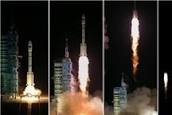
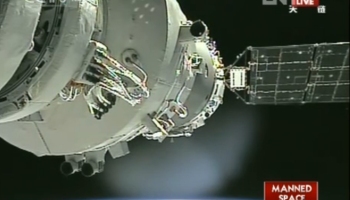
Shenzhou-11 docks with Tiangong-2 space lab

More than 40 hours after lift-off, the Shenzhou-11 spacecraft has docked with the Tiangong-2 space lab. Astronauts Jing Haipeng and Chen Dong have moved into what will be their home in space for the next month.

Shenzhou-11 spacecraft docks with Tiangong-2 space lab


The Shenzhou-11 manned spacecraft successfully completed its automated docking with the orbiting Tiangong-2 space lab at 3:31 am Wednesday Beijing Time, according to Beijing Aerospace Control Center (BACC).

Shenzhou-11, which was launched Monday morning from northwest China's Gobi Desert, began to approach Tiangong-2 automatically at 1:11 am Wednesday and made contact with the space lab at 3:24 am.

The rendezvous took place in the orbit about 393 kilometers above Earth.

The two astronauts aboard Shenzhou-11, Jing Haipeng and Chen Dong, monitored and reported on the docking operation, relaying their findings to the control center.

According to the mission schedule, once they enter the space module, the astronauts will stay there for 30 days.

Shenzhou-11, China's sixth manned spacecraft, will undertake the longest-ever space mission in the country. The two astronauts will spend a total of 33 days in space.

Sun Jun, deputy chief engineer of BACC, told Xinhua that the precision needed for the orbit prediction and automated docking calculation was much higher than previous docking missions.

China is the third country, after the United States and Russia, to complete successfully space rendezvous and docking procedures.

Tiangong-2 was sent into space on Sept. 15. It is hailed as China's first space lab "in the strict sense" and a key step in building a permanent space station, which the country aims to accomplish by 2020.

Related posts:

Graphics shows the launching process of Shenzhou-11 manned spacecraft.(Xinhua/Lu Zhe) https://youtu.be/7Jhx4J2j_kw China launches... 

Chinese astronauts Jing Haipeng (L) and Chen Dong meet the media at a press conference at the Jiuquan Satellite Launch Center in northwest...


Sep 17, 2016 ... NASA closely watches Tiangong-2 launch. The space industry has paid close attention as China sent the Tiangong-2 lab into space. NASA is ...


Wednesday, October 19, 2016

Philippine President Duterte in China for "Historic" Visit ; US Media Churlish!

Philippine President Rodrigo Duterte arrives in Beijing on October 18, 2016, beginning his state visit to China. [Photo: Chinanews.com]

 https://youtu.be/iWDQDWqZoyU


https://youtu.be/77qewVIdo3c

US media churlish on Duterte’s China visit


Philippine President Rodrigo Duterte's ongoing trip to China has been seen as a gamble by the American media. Their astonished reaction clearly shows the selfish considerations of the US and its Western allies on the South China Sea issue. They take Philippine willingness to be a loyal part of the US alliance system as granted.

While providing security to the Philippines, Washington treats Manila as a pawn. The alliance requires the Philippines to serve US interests. To Washington, the Philippines' value lies in providing military bases and legitimacy for the US containment of China in the South China Sea. As to the price Manila has to pay, it isn't a problem at all for Washington.

We don't foresee that the Philippines under the Duterte administration will break with the US. The majority of Chinese scholars on international strategy don't think it will ever happen. Duterte appears more to be striving for increased diplomatic autonomy. Instead of serving Washington's rebalance to the Asia-Pacific strategy, he is redesigning Philippine foreign policy based on Philippine interests.

Manila has shifted its China policy from one of confrontation during the Aquino era to being friendly and cooperative, as China's support is essential for its economic development. Washington needs Manila to stick to its geopolitical role, but 100 million Filipinos want a better life more.

The Philippines needs support to improve infrastructure, for which the US offers no help. Washington only sends soldiers and military equipment, but the security threat it paints is exaggerating to Filipinos.

Duterte's China visit burst the "China threat" bubble jointly blown by Aquino and the US. Arbitration and US aircraft carriers are useless in solving maritime disputes between Beijing and Manila. Friendly engagement and negotiations are more beneficial to the Philippines. Aquino was more like a gambler, betting that confronting China would win public support and that all ASEAN countries would follow the US. He lost the bet.

Development and cooperation are the major theme in Southeast Asia, but the US is pushing the region to the opposite pole for its selfish strategic gains. It is a costly strategy. Washington ties Manila and Hanoi to its chariot for its China-containment strategy in the South China Sea, but the latter could have more room to cooperate with China.

A BBC opinion piece expects Duterte to focus on the maritime disputes and re-evaluate the importance of the alliance with the US some day. Beijing does not expect the Philippines to swing fully to China, but we are also clear that the Sino-Philippine friendship is in line with the long-term interests of Duterte and the Philippines as a whole. That's enough. The US and Western mainstream media would be foolish to expect a Manila that is hostile to Beijing for Washington's South China Sea strategy. Such a scenario will probably not reappear during Duterte's term of office.

China should reciprocate Duterte’s overture


Philippine President Rodrigo Duterte embarked on his state visit to China today. This visit would have been unimaginable three months ago when the Philippines, as an initiator of the South China Sea arbitration and a key pivot of the US strategy of rebalance to the Asia-Pacific, was in sharp conflict with China over maritime disputes. Duterte has made a fresh start with Beijing-Manila ties and the nation's regional strategies after coming into office, and thus is widely regarded as a "subverter."

Duterte's straightforward way of speaking and acting has made a deep impression on the world. He extended the olive branch to China soon after taking office, making China the first country outside ASEAN for an official visit and speaking publicly in favor of Beijing. Now it's China's turn to receive his olive branch.

Since assuming office, Duterte reprioritized national affairs, taking the public's attention from the South China Sea back to domestic governance. Meanwhile, he insists on Manila's right to an independent foreign policy and opposes Washington's excessive control over the Philippines, which has riled the US. The announcement of a suspension of Washington-Manila joint patrols and military drills has particularly rocked this alliance.

The Philippines plays a special role in the South China Sea situation. Manila is Washington's ally and the most ideal pawn for Washington and Tokyo to intervene in the South China Sea issue. Duterte's predecessor Benigno Aquino III provoked strongly as he was backed by the US and Japan. Washington also counts on Manila to acquire legitimacy to launch South China Sea joint patrols. Once the Sino-Philippine relationship is returned to a friendly track, the US strategy of rebalancing will be undermined in the South China Sea.

Some are suspicious of Duterte's sincerity toward China. However, Duterte's policy has clear logic. China is his best partner in the anti-drug fight and for infrastructure construction. He is realistic and clear that the Philippines is only serving the US China-containment policy if it goes against China on the South China Sea issue.

Duterte's understandings on the Sino-Philippine relationship reflect his left-wing political ideas. Whether he can resist pressure from domestic pro-US forces is key to the issue.

We call on China to grasp this major strategic opportunity brought by the Duterte administration. At the moment, China can make more efforts to facilitate the turnaround of the bilateral relationship. Beijing-Manila ties suffered an overall retreat during Aquino's rule. Two-way trade dropped, Chinese tourist groups to Philippines stopped and fruit imports to China were affected. Changes are now happening.

The Philippine media has focused on the issue of fisheries around Huangyan Island. Duterte, under great domestic pressure, is strongly expected by Philippine media to bring a breakthrough on the issue.

Sovereignty is non-negotiable, but China can adopt a flexible policy on the Philippines' fishing rights. Filipino fishermen fish on a shoestring and are unlikely to jeopardize the ecosystem of China's waters.

A flexible fishing policy will bring the Sino-Philippine relationship to a new stage. As a major power, China should express its goodwill to Filipino fishermen and their president at this time. Washington's strategy of rebalancing to the Asia-Pacific has increased China's diplomatic and economic costs in Southeast Asia, and it is necessary for Beijing to reciprocate Manila for its clear stance of not willing to serve the US' China strategy.

It is more effective to address the disputes in a friendly, instead of a confrontational way. China should make this clear to the world to win more respect in the world.  - Global Times

Related posts:

The culture of guns As the US has lost more international status and influence since the global financial crisis in 2008, the intern...
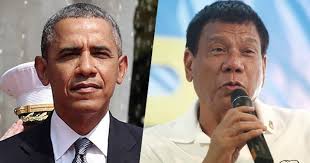
Sep 7, 2016 ... Philippine President Rodrigo Duterte called Barack Obama a "son of a w****"/" son of a bitch" on Monday as he vowed not to be lectured by the ...
 
 Philippine President calls Obama the "son of a bitch", reveals cracks in ties as he refuses to be lectured on human rights 

US media wanted 'special privileges'

World doubts the leadership of Uncle Sam: expert


The culture of guns

As the US has lost more international status and influence since the global financial crisis in 2008, the international community is raising doubts about its leadership and ability to contribute to the world, an expert said, analyzing that such a decline of influence can be attributed to some deep-seated reasons, including its self-willed overseas military operations.

Since the financial crisis, the US can neither provide effective solutions to a host of global challenges, nor sustain its control over other countries, Zhang Ruizhuang, Director of the Center of American Studies at Nankai University, wrote in an article published in the People’s Daily on Sunday.

In the commentary titled “The City upon a Hill is not there any more,” he gave an in-depth analysis on the reasons of such changes.

Zhang says that “A City upon a Hill,” often cited by American politicians as their political creed, verified the self-labelling of the arrogant Americans as “God's Chosen Ones” to lead the world. After the Cold War, the preaching about the superiority of its values brought US much popularity and pulled the country to a commanding stage.

But it over-consumed its accumulated political capital during the last quarter of the 20th century, which resulted in a decline in its global influence, Zhang said, adding that the most destructive threat to its dropping status can be attributed to overseas military operations.

After the Soviet Union collapsed with the end of the Cold War, the US dominated the world and launched a series of capricious measures. With the excuse of protecting democracy, human rights and the world order, Uncle Sam trampled on the post-war international law based on the UN Charter and norms governing global relations by bringing the flames of war to many parts of the world.

Panama, Somalia, Haiti and Kosovo are all victims of such wars waged by the superpower. With a made-up excuse, it pulled Iraq into a war and this political farce finally brought the latter millions of civilian casualties, endless terrorist attacks and ceaseless disturbance.

What the US gained, after it paid a price of trillions of dollars for the war, was a hotbed for terrorist organizations which in turn threatened the security of itself and other Western countries. The war against Iraq ultimately turned out to be a foolish one that not only crumbled its diplomatic morality, but undermined its own strategic interests, Zhang concluded.

Despite the lessons, the US never gave up every opportunity to start “color revolutions.” Its attacks on Libya and Syria, once again, dragged these nations into raging wars. What’s worse, as a result of the wars, a number of regulation vacuums provided ISIS and other religious extremist organizations a bed in which to grow stronger.

The US, its Western allies, as well as the whole world, are now swallowing the sour fruits resulted from its self-willed deed, he added.

According to the scholar, apart from its frequent diplomatic mistakes, its economy, politics and society, in which the Americans once took pride, are all in a predicament, arising more doubts over the superiority of the US system.

The global financial crisis breaking out in 2008 exposed the defects of capitalism once again. It brought to light not only the failure of Keynesian policy to narrow the wealth gap and boost effective demand, but the greed and corruption of financial executives, the ineffectiveness of financial supervision, plus the government’s shielding of tycoons.

The US public felt shock, despair and anger towards such defects, and the ensuing “Occupy Wall Street” movement is one of their ways to express dissatisfaction. The protest wave later spilled to other part of the world, triggering worldwide query over the US system and its values.

Zhang also criticized US domestic politics, citing its notorious presidential election system as an example.

Manipulated by capital, the “winner takes all” election system in many states gives no chance to other newborn parties besides the two major parties. The American elections of the past two to three decades have been more like technical games.

The candidates now focus more on technical details for the sake of more votes rather than their political ideas and governance philosophies, and the whole process has fallen into personal attacks between the two candidates, he added.

Coupled with some other faults, the US and even the whole world began to question on the effectiveness of US democracy, as well as its leader selected in such a flawed way.

The article analyzed that one key reason for its flopping election lies in a lack of innovative governing ideas.

Barely stimulated by major crisis, US society tends to be mediocre and conservative about its ideas, the commentary further explained, adding that the prevailing philosophy of so-called “political correctness” also created an unfavorable environment for the candidates to come up with new ideas acceptable to the public.

Lack of foresighted candidates with outstanding capability is another reason for its unsuccessful election, Zhang wrote.

He explained that some capable politicians are not willing to embarrass themselves on the election stage at the cost of their privacy and that of their family as the butt of jokes.

“As a result, the world was presented with an election farce performed by the two unqualified and big-mouth candidates selected by the two parties,” the author concluded.

“It is obvious that the US is seeing a decline in terms of both prestige and influence, but such a drop is not so eye-catching as it has no strong competitors yet. It would be a complicated historic path,” the scholar said, calling for more attention to the course of the world pattern.

 (People's Daily)

Related posts:

US presidential hopefuls show a country lacking in leadership, debate falls into trite format


Modern finance and money being managed like a Ponzi scheme ! Economic Collapse soon?